VERANSTALTUNG IST AUSGEBUCHT
(for english, please scroll down)
Programmheft zur Tagung der Kunstkommission Düsseldorf
Der öffentliche Raum stellt ein komplexes Gefüge dar, das stets neu verhandelt wird – sozial, politisch, ästhetisch und symbolisch. Angesichts zunehmender Verdichtung, gesellschaftlicher Fragmentierung und politischer Polarisierung verschärfen sich diese Aushandlungsprozesse. Dies ist auch der Fall, wenn es um die Rolle von Kunst im öffentlichen Raum geht – sei es im Rahmen der Realisierung von neuen Projekten oder im Umgang mit Bestandskunst. Ein aktuelles Beispiel hierfür ist die 2024 in Düsseldorf entbrannte Debatte um die Fassade des ehemaligen Audimax der Hochschule Düsseldorf, gestaltet von Günter Fruhtrunk. Der geplante Abriss des Gebäudes und die damit verbundene mögliche Demontage des Kunstwerks haben eine breite öffentliche und kulturpolitische Diskussion ausgelöst, in der städtebauliche Interessen auf Denkmalschutz und künstlerische Autor*innenschaft treffen. Auch Argumente des “Kulturkampfs” spielen in diesen Debatten eine Rolle, zwischen der Moderne und rechter Raumnahme.
Wer aber entscheidet über den Erhalt öffentlicher Kunstwerke? Welche Interessen und Machtverhältnisse bestimmen diese Entscheidungen? Und wie gestaltet sich das Verhältnis von Deutungshoheit, Zugang und Teilhabe? Die Fachtagung nimmt diese Fragen zum Anlass, um die vielschichtigen Dimensionen des öffentlichen Raums sowie die Rolle der Kunst als Medium gesellschaftlicher Mitgestaltung, Kritik und Transformation zu untersuchen. Neben dem Umgang mit Bestandskunst sollen vor allem künstlerische und kuratorische Strategien verhandelt werden, die bestehende Machtstrukturen sichtbar machen, hinterfragen oder strategisch unterwandern. Dabei liegt der Fokus auf der Praxis von Akteur*innen, die im Stadtraum weniger sichtbar sind – wie queerfeministischen Perspektiven –, ebenso wie auf Praktiken der Kollaboration als Form der Teilhabe. Des Weiteren rücken künstlerische Strategien in den Blick, die die ökologische und soziale Transformation mitgestalten, sowie Kunstprojekte, die den öffentlichen Raum ins Digitale erweitern.
Die Tagung bringt Künstler*innen, Kurator*innen, Wissenschaftler*innen und Akteur*innen der Stadtgesellschaft zusammen, um gemeinsam über die Gestaltungsspielräume und die transformative Kraft von Kunst im öffentlichen Raum zu reflektieren. Neben eingeladenen Keynote-Speaker*innen und Diskussionsteilnehmer*innen wird das Programm durch Beiträge aus einem Call for Papers ergänzt. In insgesamt fünf Panels werden die verschiedenen Dimensionen und Perspektiven von Raum verhandelt.
Organisiert wird die Tagung von der Kunstkommission der Landeshauptstadt Düsseldorf. Seit 2018 beschäftigt sich die Kommission mit Kunst und Bau-Projekten, begleitet interdisziplinäre städtebauliche Vorhaben und richtet temporäre Formate wie den Lantz’scher Skulpturenpark sowie die international ausgeschriebenen stadt.raum.experimente aus.
Die Tagung findet vom 20. bis 21. März 2026 im Künstlerverein Malkasten in Düsseldorf statt. Sie beginnt am Freitag um 13 Uhr und endet am Samstag gegen 14 Uhr. Alle interessierten Bürgerinnen und Bürger sind herzlich eingeladen, an der Tagung teilzunehmen und sich aktiv einzubringen.
Der Kulturwissenschaftler Kay von Keitz führt moderierend durch das Programm.
Die Teilnahme ist kostenfrei.
Die Tagung ist bereits ausgebucht. Anmeldungen sind nur noch für die Warteliste möglich: kunstkommission@duesseldorf.de
Tagungsprogramm
Freitag, 20.3.2026
13-19 Uhr
13:00 Open Doors
13:15 Begrüßung und Einführung
– Johanna Adam (Vorsitzende der Kunstkommission Düsseldorf)
13:30 Beginn
Aushandlungsräume – Umgang mit Bestandskunst im Stadtraum
Kunst im öffentlichen Raum ist nicht nur Ausdruck ästhetischer Gestaltung, sondern auch Trägerin gesellschaftlicher Werte, Narrative und Geschichtsverständnis. Viele Werke im Stadtraum sind historisch gewachsen – sie wurden in anderen politischen und sozialen Kontexten geschaffen und stoßen heute zunehmend auf Kritik, Widerspruch oder Forderungen nach Umdeutung. Dieses Panel widmet sich der Frage, wie mit bestehenden Denkmälern und Skulpturen umgegangen werden kann und soll. Wie lassen sich problematische Inhalte oder überkommene Repräsentationsformen erkennen, diskutieren und transformieren? Welche künstlerischen oder kuratorischen Strategien des Umgangs mit diesen Arbeiten gibt es bereits – etwa Kontextualisierungen, Gegendenkmäler, temporäre Überarbeitungen oder partizipative Prozesse?
13:35 Keynote
Besetzen, bespielen, befragen – Kunst im öffentlichen Raum als Aneignungsmöglichkeit
– Julia Grosse (Kunsthistorikerin, Gropius Bau)
Immer noch verorten die meisten Menschen Kunst und ihre Präsentation in den geschlossenen Raum: Museen, Kunsthallen und Galerien, in die längst nicht alle den Mut oder gar die Lust haben, hineinzugehen. Obwohl die Kulturhäuser längst und zum Teil auch äußerst spannend an Öffnungsprozessen arbeiten. Die Kunst im öffentlichen Raum, ob temporär oder langfristig gedacht, ist demgegenüber eine Chance, in die Begegnung zu gehen mit einer Audience, die ohnehin da ist. Und weil die öffentlichen Räume enger werden, ist die Präsenz von Kunst wichtig, die jenseits der bloßen Repräsentation funktioniert, formuliert, irritiert. Sie bezieht Stellung zu Themen der Gegenwart, trifft Aussagen und regt zum Nachdenken an. Kunst, die partizipativ gedacht oder so angelegt ist, dass eine Stadtgesellschaft sie sich aus ganz unterschiedlichen Perspektiven aneignen kann; Als Ort, der beklettert, berührt, bespielt werden darf; Als offene Bühne, die zum Austausch einlädt; Als konsumfreier Ort des Rückzugs. Und auch kontroverse historische Denkmäler im Stadtraum werden längst aktiv (und oft ungefragt) kritisch und zum Teil höchst kreativ in die Pflicht genommen.
13:45 Impuls
Abschied und Transformation
– Sebastian Freytag (Künstler)
In seinem Vortrag stellt Sebastian Freytag ein künstlerisches Konzept zum Umgang mit historischen Kunst-am-Bau-Werken vor. Ausgehend vom Gedanken des Abschieds werden Möglichkeiten untersucht, historisches künstlerisches Erbe neu zu denken – insbesondere dort, wo Werke, Materialien und Konzepte der Nachkriegsmoderne ihre ursprüngliche Funktion verlieren und zu neuem Handeln auffordern. Historisches Material wird dabei nicht als abgeschlossen betrachtet, sondern als offene Ressource, welche durch eine zeitgenössische künstlerische Praxis neu befragt und transformiert werden kann. Anhand ausgewählter Projekte werden mögliche Formen eines dialogischen Umgangs mit historischem Material vorgestellt. Vergangenheit und Gegenwart treten dabei in Resonanz und eröffnen Denk- und Handlungsräume, in denen künstlerisches Erbe als wandelbar, offen und produktiv erfahrbar wird.
13:55 Podiumsdiskussion
mit Julia Grosse (Kunsthistorikerin, Gropius Bau), Sebastian Freytag (Künstler) und Tillmann Terbuyken (Künstler) sowie Max Brück (Künstler)
15:15 Pause
15:30 Beginn
Handlungsräume – Zwischen Selbstorganisation und Protest
In diesem Panel soll untersucht werden, wie sich künstlerische, performative und aktivistische Praktiken in urbanen Räumen entfalten, die durch Selbstorganisation, Protestbewegungen und kollektives Handeln geprägt sind. Der öffentliche Raum ist nicht nur Bühne für Sichtbarkeit, sondern ein umkämpfter Ort politischer und gesellschaftlicher Auseinandersetzungen. Hier entstehen temporäre Allianzen, kreative Widerstandsformen und alternative Öffentlichkeiten. Wie lässt sich der Stadtraum als Handlungsraum nutzen, in dem bestehende Machtverhältnisse hinterfragt, gestört oder neu verhandelt werden? Welche Rolle spielen selbstorganisierte Strukturen – etwa Initiativen, Kollektive oder informelle Zusammenschlüsse – im Kontext künstlerisch-politischer Interventionen? Und wie bewegen sich diese zwischen institutioneller Kooperation, Autonomie und Widerstand?
15:35 Keynote
Von der Anziehungskraft des Zentrums und den Zentrifugalkräften der Zerstreuung
– Britta Peters (Urbane Künste Ruhr)
Urbane Künste Ruhr ist aus dem Programm Stadt der Möglichkeiten des Kulturhauptstadtjahrs Ruhr.2010 hervorgegangen. Das Aufgabenheft der Anfangsjahre war prall gefüllt mit hohen Erwartungen an die junge Institution: Sie sollte das Ruhrgebiet zusammenschweißen, den regionalen Künstler*innen zu mehr Präsenz verhelfen und die Region insgesamt aufwerten. 15 Jahre später sind sowohl die Institution als auch die Ansprüche an sie gereift. Mit einem klaren Fokus auf kontextspezifischen Neuproduktionen bekennt sich Urbane Künste Ruhr zu den Eigenwilligkeiten der Kunst, ohne den öffentlichen Raum als Handlungsfeld aus dem Blick zu verlieren. Aber wie kann das gehen? Anhand von zwei Langzeitprojekten werden Thesen darüber aufgestellt, welche physischen, kommunikativen und gedanklichen Räume durch bestimmte Konstellationen entstehen und welche Faktoren ihre Entwicklung behindern.
15:45 Impuls
Parasite the public: Camouflage, Infiltration und die Entgrenzung von Öffentlichkeit, Alltag und Kunst
– Jakob Margit Wirth (Künstler*in)
Im Vortrag untersucht Jakob Margit Wirth parasitäre Taktiken künstlerischer Praxis im öffentlichen Raum – Taktiken der Infiltration, Camouflage und situativen Besetzung –, die die Differenz zwischen Kunst und Alltag bewusst auflösen. Im künstlerischen Forschungsprojekt Parasite Art (PhD, Bauhaus-Universität Weimar) geht es Wirth um das Herausarbeiten jener Formen künstlerischer Praxis, die resilient gegenüber hegemonialen Strukturen agieren. Bei diesen parasitären Interventionen versteht Wirth die Öffentlichkeit als bestehende Sphäre, die sich durch aufsuchende, performative Praxis bespielen lässt. Anhand zweier Projekte – Parasite Parking und Collapse Collection – wird gezeigt, wie diese parasitären Taktiken neue Räume für Kritik, Reflexion und Teilhabe eröffnen.
15:55 Podiumsdiskussion
mit Britta Peters (Urbane Künste Ruhr), Jakob Margit Wirth (Künstler*in), Martin Krenn (HBK Braunschweig) und Anne Schülke (Künstlerin)
17:00 Pause
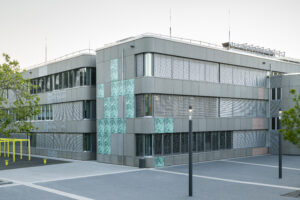
Nina Beier, 2022
Friedrich-Rückert-Gymnasium
Foto: Katja Illner
17:15 Beginn
Anerkennungsräume – Queerfeministische und andere Un/Sichtbarkeiten im öffentlichen Raum
Mit der Errichtung des LGBTIQ+-Denkmals von Claus Richter hat Düsseldorf einen wichtigen Schritt in Richtung Sichtbarkeit und Anerkennung der LGBTIQ+-Gemeinschaft gemacht. Das Denkmal stellt ein öffentliches Zeichen für Akzeptanz und Integration queerfeministischer Perspektiven im Stadtraum dar und steht für eine queere, diverse Erinnerungskultur. Doch wie kann der öffentliche Raum darüber hinaus genutzt werden, um Themenfelder wie Gleichberechtigung, Selbstbestimmung und sexuelle Vielfalt zu fördern, aber auch Kontroversen wie Geschlechterrollen und historischer wie aktueller Diskriminierung zu thematisieren? Welche Strategien lassen sich entwickeln, um diese marginalisierten Themen nicht nur sichtbar zu machen, sondern als integralen Teil des urbanen Alltags langfristig zu verankern?
17:20 Keynote
Out in the City – Queere Raumaneignung als gesellschaftliche und künstlerische Praxis
– Yvonne P. Doderer (Künstler*in und Architekt*in)
Vor allem das Leben in der Stadt kann die Formierung von emanzipatorischen, identitätspolitischen und queeren Bewegungen ermöglichen. Es kann ihre vielfältigen Formen von Gemeinschaftsbildung, ihre Strategien der Verräumlichung im Urbanen und als urbane Räume begünstigen. Seit ihrer Entstehung haben diese Bewegungen zu einer Veränderung von städtisch-gesellschaftlichen Verhältnissen produktiv beigetragen. Kunst im öffentlichen Raum als (nicht nur) queer-feministisch-künstlerische Praxis wiederum kann zu einer Schnittstelle werden, die die Zusammenhänge von Stadt und Emanzipation, von damit verbundenen Geschichte/n, Denkweisen und Strategien sichtbar macht und reflektiert. Eine solchermaßen motivierte Kunst ist jedoch in städtisch-öffentlichen Räumen bislang kaum oder wenn, dann meist nur temporär zu finden.
Die Gründe hierfür sind zu diskutieren.
17:30 Lesung
„… und auf dem Gehweg habe ich auf einmal, fast unmerklich, wie magisch Platz“
– Jonas Monka (Künstler)
In seinen autofiktionalen Texten, die Jonas Monka seit einem Jahr als Teil seiner künstlerischen Arbeit begreift, lässt er in tagebuchartigen Einträgen phantastische Bilder entstehen. Ausgehend von seinem Körper, der weiblich sozialisiert wurde und nun weitestgehend als männlich gelesen wird, übersetzt er somatische Erfahrungen in Sprache. Die hier vorgetragenen Texte kreisen um die Un/Sichtbarkeiten, Bewegungsmuster und Begegnungen zwischen Körpern und Skulpturen in öffentlichen und in intimen Räumen.
17:40 Podiumsdiskussion
mit Yvonne P. Doderer (Künstler*in und Architekt*in), Jonas Monka (Künstler), Viron Erol Vert (Künstler) und Maximiliane Baumgartner (Künstlerin, Kunsthochschule Mainz)
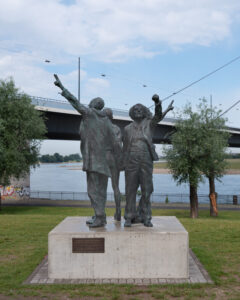
Claus Richter
Rheinwiese, 2022
Foto: Christian Konrad
19:00 Get-Together
Samstag, 21.3.2026
9-14 Uhr
9:00 Open Doors
9:15 Recap
– Julia Reich und Christoph Schäfer (Mitglieder der Kunstkommission Düsseldorf)
9:30 Beginn
Digitalräume – Öffentliche Kunstpraxis zwischen Virtualität und Urbanität
Digitale Räume entwickeln sich zunehmend zu eigenständigen Öffentlichkeiten für künstlerische, kuratorische und kulturelle Praktiken. Dieses Panel widmet sich der Frage, wie digitale Infrastrukturen – von sozialen Medien über immersive Plattformen bis hin zu Augmented und Mixed Reality – neue Formen von Sichtbarkeit, Teilhabe und Gemeinschaft ermöglichen. Im Fokus stehen digitale Kunstprojekte, die sich mit urbanen, gesellschaftlichen oder politischen Fragen auseinandersetzen und dabei die Grenzen zwischen physischem Stadtraum und virtuellen Handlungsfeldern verschieben. Wie kann digitale Kunst den öffentlichen Raum erweitern, kommentieren oder transformieren?
Inwiefern entstehen durch ortsbezogene digitale Formate neue Perspektiven auf Stadt, Erinnerung und Gemeinschaft?
9:35 Keynote
Meta-Monuments: Gegen die Last der Vergangenheit
– Mara-Johanna Kölmel (Kuratorin, Zeppelin Museum Friedrichshafen)
Wie verändern digitale Technologien unser Verständnis von Denkmälern? Welche alternativen Erinnerungsorte entstehen, wenn Machtansprüche ihren Sockel verlieren? Seit dem 19. Jahrhundert haben sich Bedeutung und Funktionen von Denkmälern grundlegend gewandelt: von heroischen, national aufgeladenen Symbolen hin zu umkämpften Orten, die historische Brüche, verdrängte Erinnerungen und marginalisierte Perspektiven markieren. Heute erweitern digitale Technologien, immersive Medien und netzbasierte Öffentlichkeiten dieses Verständnis weiter hin zu immateriellen, virtuellen und ortsungebundenen Formen des Gedenkens. Der Impuls-Vortrag widmet sich Künstler*innen, die das Vokabular von Denkmälern kritisch befragen und neu codieren. In einer Zeit, in der Denkmäler zunehmend zu politischen Konfliktzonen werden, untersucht der Vortrag Möglichkeitsräume für neue Formen des Gedenkens. Ausgehend vom Begriff der nomadischen Monumentalität erkundet er ein künstlerisches Experimentierfeld für alternative Öffentlichkeiten, marginalisierte Stimmen und kollektive Erinnerung.
9:45 Impuls
Artists in Public Innovation. Kunstpraxis im Kontext digitaler und partizipativer Stadtplanung in Amsterdam
– Cindy Wegner (Künstlerin)
In europäischen Städten wächst das Bewusstsein dafür, dass künstlerische Ansätze als Katalysator für soziale Innovation und Gemeinwohlorientierung eingesetzt werden können. Die Integration von Kunst und Kultur in kommunale Strukturen eröffnet neue Perspektiven auf soziale Komplexität und ermöglicht experimentelle Ansätze, die klassische Verwaltungsinstrumente häufig nicht leisten können. Das Rechercheprojekt Artists in Public Innovation untersucht, wie künstlerisch kuratierte Formate innerhalb der Stadtverwaltung Innovation, Beteiligung und organisationsinternes Lernen stärken. Es beleuchtet anhand einer Fallstudie aus Amsterdam im Rahmen des Digital Urban Planning Lab, wie künstlerische Praxis als integrales Element kommunaler Innovationspolitik wirkt und zur Umsetzung städtischer Strategien in den Bereichen digitale Transformation, Kunst im öffentlichen Raum, Partizipation, Identität und lernende Verwaltung beiträgt.
9:55 Podiumsdiskussion
mit Mara-Johanna Kölmel (Kuratorin, Zeppelin Museum Friedrichshafen), Cindy Wegner (Künstlerin) und Tina Sauerländer (freie Kuratorin) sowie Achim Mohné (Künstler)
11:00 Pause
11:15 Beginn
Spaces of Sustainability – Art as a Practice of Ecological and Social Transformation (EN)
In light of global ecological crises, social inequality and multiple systemic challenges, this panel asks: What role can art in public space play in shaping sustainable futures? The panel focuses on artistic strategies that address and actively contribute to ecological and social transformation. How can public art raise awareness of environmental issues and foster collective ecological consciousness? What part do participatory, site-specific, or process-based approaches play in making alternative ways of living, economic systems, and resource use visible—or even tangible? Which alliances are emerging between art, activism and urban society in the name of sustainability, and how can these be secured in the long term?
11:20 Keynote
Design for Co-resilience
– Doina Petrescu (Professor of Architecture and Design Activism, University of Sheffield)
Co-resilience is the ability of groups and communities to thrive together during times of crisis. It relies on shared resources, mutual support, and the co-creation of new possibilities. Ideally, this can take the form of a commons-based, citizen-driven process, rooted in collaboration, care and collective action. Co-resilience operates across multiple scales—from the micro-level, within small, local groups, to the macro-level, where broader systems and communities come together to address larger challenges. It is also an inner, personal process, one that involves becoming more knowledgeable, skilled, and capable of responding to evolving needs but also more able to care. This dual approach—one that focuses on both the individual and the collective action—helps to build lasting, adaptable resilience within communities. As designers, artists, and cultural workers, we can develop tools for co-resilience that can be taken up, adapted, and further developed by others. The lecture will explore some of these tools through the lens of 15 years of experience with R-Urban, a participatory resilience strategy based on networks of eco-civic hubs, initiated by atelier d’architecture autogérée in the Parisian region.
11:30 Short Talk
Reading Site Responsiveness with Donna Haraway
Christoph Chwatal / Ludovica Tomarchio (Researcher, University of Vienna/Berlin University of the Arts)
This contribution proposes a shift from site specificity to site responsiveness in contemporary artistic and architectural practices. We conceive of site as a complex node where ecological, technological, and social processes converge. Such a view is necessary given today’s planetary condition, marked by climate change, migration, technological acceleration, and systemic interdependence. As Dipesh Chakrabarty argues, the notion of the “planet” increasingly displaces the anthropocentric “globe” associated with the idea of sustainability. Moving beyond sustainability, we emphasize entangled, morethan-human agencies. Responding to these complexities requires shifting from site specificity to site responsiveness. We explore responsiveness in relation to responsibility through a close reading of Donna Haraway’s work.
11:40 Panel discussion
with Doina Petrescu (Professor of Architecture and Design Activism, University of Sheffield), Christoph Chwatal and Ludovica Tomarchio (Researcher, University of Vienna/Berlin University of the Arts), Elisabeth von Samsonow (Artist) und Va-Bene Elikem Fiatsi (Artist)
12:45 Pause
13:00 Performance
– Christi Knak Tschaikowskaja
„Oecophyllas gemeinsamer Faden“
Die Performer.innen (drei insgesamt) verlassen sich auf ihre Stärken im Atem. Ein gegenseitiger Atemaustausch wird Wegbereiter und rote Linie des Raums.
Christi Knak Tschaikowskaja ist Performance-Künstler.in und Maler.in. Mit dem Medium der Performance-Kunst arbeitet Christi als Gestaltungsmittel von “Lebensräumen”. Ihre Malerei stellt sich der Herausforderung, eine Arbeit mit kontemporären Kräften zu sein. Gesellschaftliche Dynamiken nehmen tierische Formen an, wobei hier das “Tier” ein solches ist, das unter der menschlichen Unterdrückung leidet. Insgesamt bilden sich ephemer oder malerisch organische Anziehungsanordnungen ab: Massen, Bewegungen, dazwischen Zärtlichkeit. Christi studierte an der Kunsthochschule für Medien in Köln und an der Kunstakademie Düsseldorf in den Klassen von Gregor Schneider und Kati Heck.
13:30 Fazit und Get-Together
14:00 Ende
Symposium of the Art Commission of the City of Düsseldorf
20–21, 2026, Künstlerverein Malkasten Düsseldorf
Public space is a complex fabric that is constantly being renegotiated in social, political, aesthetic and symbolic terms. Amid increasing urban density, societal fragmentation, and political polarisation, these negotiation processes are intensifying. This also applies to the role of art in public space, whether in the realisation of new projects or in the treatment of existing public artworks. A recent example of this is the debate in Düsseldorf in 2024 surrounding the façade of the former Audimax at Düsseldorf University of Applied Sciences, which was designed by Günter Fruhtrunk. Plans to demolish the building and dismantle the artwork sparked a wide-ranging public and cultural-political discussion, where urban development interests clashed with heritage preservation and artistic authorship. Such debates reflect elements of today’s ‘culture wars’, particularly the conflict between modernist values and the spatial appropriation of far-right groups.
But who decides which public artworks are preserved? What interests and power structures influence these decisions? How is the relationship configured between interpretive authority, access, and participation? Taking these questions as a starting point, the symposium will explore the multifaceted dimensions of public space and the role of art as a medium for social co-creation, critique, and transformation. As well as examining existing public artworks, we will discuss artistic and curatorial strategies that expose, question, or strategically subvert existing power structures. Particular focus will be given to the practices of underrepresented groups in urban spaces, such as queer-feminist perspectives, and to collaborative practices as a form of participation. We will also explore artistic strategies that contribute to ecological and social transformation, as well as art projects that extend public spaces into the digital realm.
The symposium brings together artists, curators, researchers, and civic actors to consider how public spaces can be shaped, and to reflect on the transformative power of art in urban environments. In addition to invited keynote speakers and panellists, contributions from a call for papers will supplement the programme. The symposium comprises five panel discussions, each addressing a different dimension of spatial negotiation.
The symposium is organized by the Art Commission of the City of Düsseldorf. Since 2018, the Art Commission has been engaged with public art and building projects, supports interdisciplinary urban planning initiatives, and organizes temporary formats such as the Lantz’scher Skulpkturenpark and the internationally tendered stadt.raum.experimente.
The symposium takes place from March 20–21, 2026 at Künstlerverein Malkasten in Düsseldorf. It will start on Friday 20 March at 1 pm and end on Saturday 21 March at around 2 pm. All interested citizens are warmly invited to participate in the conference and actively engage.
Participation is free.
The conference is fully booked. Registrations are now only being accepted for the waiting list: kunstkommission@duesseldorf.de
Panels
1:00 p.m. Open Doors
1:15 p.m. Welcome and introduction
– Johanna Adam (Chair of the Düsseldorf Art Commission)
1:30 p.m. Start
Negotiation spaces – dealing with existing art in urban spaces
Art in public spaces is not only an expression of aesthetic design, but also a vehicle for social values, narratives, and historical understanding. Many works in urban spaces have grown historically – they were created in different political and social contexts and are now increasingly encountering criticism, opposition, or demands for reinterpretation. This panel is dedicated to the question of how existing monuments and sculptures can and should be dealt with. How can problematic content or outdated forms of representation be identified, discussed, and transformed? What artistic or curatorial strategies for dealing with these works already exist—such as contextualization, counter-monuments, temporary reworkings, or participatory processes?
1:35 p.m. Keynote speech
Occupying, performing, questioning—art in public spaces as an opportunity for appropriation
—Julia Grosse (art historian, Gropius Bau)
Most people still associate art and its presentation with enclosed spaces: museums, art halls, and galleries, which not everyone has the courage or even the desire to enter. This is despite the fact that cultural institutions have long been working on opening up their doors, in some cases with extremely exciting results. Art in public spaces, whether temporary or long-term, offers an opportunity to engage with an audience that is already there. And because public spaces are becoming more confined, the presence of art that functions beyond mere representation, that formulates and provokes, is important. It takes a stand on contemporary issues, makes statements, and encourages reflection. Art that is participatory in nature or designed in such a way that an urban society can appropriate it from very different perspectives; as a place that can be climbed, touched, played on; as an open stage that invites exchange; as a consumption-free place of retreat. And even controversial historical monuments in urban spaces have long been actively (and often unsolicited) critically and, in some cases, highly creatively called to account.
1:45 p.m. Impulse
Farewell and Transformation
– Sebastian Freytag (Artist)
In his lecture, Sebastian Freytag presents an artistic concept for dealing with historical art-in-architecture works. Starting from the idea of farewell, he explores possibilities for rethinking historical artistic heritage—especially where works, materials, and concepts of postwar modernism lose their original function and call for new action. Historical material is not regarded as something that is complete, but rather as an open resource that can be reexamined and transformed through contemporary artistic practice. Selected projects are used to present possible forms of dialogical engagement with historical material. The past and present resonate with each other, opening up spaces for thought and action in which artistic heritage can be experienced as changeable, open, and productive.
1:55 p.m. Panel discussion
with Julia Grosse (art historian, Gropius Bau), Sebastian Freytag (artist), Tillmann Terbuyken (artist), and Max Brück (artist)
3:15 p.m. Break
3:30 p.m. Start
Spaces for Action – Between Self-Organization and Protest
This panel will examine how artistic, performative, and activist practices unfold in urban spaces characterized by self-organization, protest movements, and collective action. Public space is not only a stage for visibility, but also a contested site of political and social conflict. This is where temporary alliances, creative forms of resistance, and alternative publics emerge. How can urban space be used as a space for action in which existing power relations are questioned, disrupted, or renegotiated? What role do self-organized structures—such as initiatives, collectives, or informal associations—play in the context of artistic-political interventions? And how do these move between institutional cooperation, autonomy, and resistance?
3:35 p.m. Keynote
On the gravitational pull of the center and the centrifugal forces of dispersion
– Britta Peters (Urbane Künste Ruhr)
Urbane Künste Ruhr emerged from the City of Opportunities program of the Ruhr.2010 European Capital of Culture year. In its early years, the young institution had high expectations to fulfill: it was supposed to bring the Ruhr region together, help regional artists gain more visibility, and enhance the region as a whole. Fifteen years later, both the institution and the demands placed on it have matured. With a clear focus on context-specific new productions, Urbane Künste Ruhr is committed to the idiosyncrasies of art without losing sight of public space as a field of action. But how can this be achieved? Based on two long-term projects, theses are put forward about which physical, communicative, and intellectual spaces are created by certain constellations and which factors hinder their development.
3:45 p.m. Impulse
Parasite the public: Camouflage, infiltration, and the blurring of boundaries between public life, everyday life, and art
– Jakob Margit Wirth (artist)
In this lecture, Jakob Margit Wirth examines parasitic tactics of artistic practice in public space—tactics of infiltration, camouflage, and situational occupation—that deliberately dissolve the difference between art and everyday life. In the artistic research project Parasite Art (PhD, Bauhaus University Weimar), Wirth focuses on identifying those forms of artistic practice that act resiliently against hegemonic structures. In these parasitic interventions, Wirth understands the public sphere as an existing sphere that can be played with through outreach and performative practice. Two projects—Parasite Parking and Collapse Collection—demonstrate how these parasitic tactics open up new spaces for criticism, reflection, and participation.
3:55 p.m. Panel discussion
with Britta Peters (Urbane Künste Ruhr), Jakob Margit Wirth (artist), Martin Krenn (HBK Braunschweig), and Anne Schülke (artist)
5:00 p.m. Break
Nina Beier, 2022
Friedrich-Rückert-Gymnasium
Foto: Katja Illner
5:15 p.m. Start
Spaces of recognition – Queerfeminist and other visibilities/invisibilities in public spaces
With the erection of Claus Richter’s LGBTIQ+ monument, Düsseldorf has taken an important step toward visibility and recognition of the LGBTIQ+ community. The monument is a public symbol of acceptance and integration of queerfeminist perspectives in urban space and stands for a queer, diverse culture of remembrance. But how can public space be used beyond this to promote issues such as equality, self-determination, and sexual diversity, but also to address controversies such as gender roles and historical and current discrimination? What strategies can be developed to not only make these marginalized issues visible, but also to anchor them as an integral part of everyday urban life in the long term?
5:20 p.m. Keynote
Out in the City – Queer Appropriation of Space as Social and Artistic Practice
– Yvonne P. Doderer (artist and architect)
Life in the city, in particular, can enable the formation of emancipatory, identity-political, and queer movements. It can favor their diverse forms of community building, their strategies of spatialization in the urban environment, and as urban spaces. Since their inception, these movements have contributed productively to a change in urban social conditions. Art in public space as (not only) a queer-feminist-artistic practice, in turn, can become an interface that reveals and reflects on the connections between the city and emancipation, and the associated histories, ways of thinking,and strategies. However, art motivated in this way has so far been rare in urban public spaces, and when it has been found, it has usually been only temporary.
The reasons for this are open to discussion.
5:30 p.m. Reading
“… and on the sidewalk, I suddenly, almost imperceptibly, magically have space”
– Jonas Monka (artist)
In his autofictional texts, which Jonas Monka has been writing for a year as part of his artistic work, he creates fantastical images in diary-like entries. Starting from his body, which was socialized as female and is now largely read as male, he translates somatic experiences into language. The texts presented here revolve around the (in)visibilities, movement patterns, and encounters between bodies and sculptures in public and intimate spaces.
5:40 p.m. Panel discussion
with Yvonne P. Doderer (artist and architect), Jonas Monka (artist), Viron Erol Vert (artist), and Maximiliane Baumgartner (artist, Mainz Academy of Fine Arts)
Claus Richter
Rheinwiese, 2022
Foto: Christian Konrad
7.00 p.m Get-Together
9:00 Open Doors
9:15 Recap
– Christoph Schäfer and Julia Reich (members of the Düsseldorf Art Commission)
9:30 Start
Digital spaces – Public art practice between virtuality and urbanity
Digital spaces are increasingly developing into independent public spheres for artistic, curatorial, and cultural practices. This panel addresses the question of how digital infrastructures – from social media and immersive platforms to augmented and mixed reality – enable new forms of visibility, participation, and community. The focus is on digital art projects that address urban, social, or political issues, thereby shifting the boundaries between physical urban space and virtual fields of action. How can digital art expand, comment on, or transform public space?
To what extent do location-based digital formats create new perspectives on the city, memory, and community?
9:35 Keynote
Meta-Monuments: Against the Burden of the Past
– Mara-Johanna Kölmel (Curator, Zeppelin Museum Friedrichshafen)
How are digital technologies changing our understanding of monuments? What alternative places of remembrance emerge when claims to power lose their pedestal? Since the 19th century, the meaning and functions of monuments have changed fundamentally: from heroic, nationally charged symbols to contested sites that mark historical ruptures, repressed memories, and marginalized perspectives. Today, digital technologies, immersive media, and network-based publics are further expanding this understanding toward immaterial, virtual, and location-independent forms of remembrance. This keynote lecture focuses on artists who critically question and recode the vocabulary of monuments. At a time when monuments are increasingly becoming zones of political conflict, the lecture explores possibilities for new forms of commemoration. Starting from the concept of nomadic monumentality, it explores an artistic field of experimentation for alternative publics, marginalized voices, and collective memory.
9:45 Impuls
Artists in Public Innovation. Kunstpraxis im Kontext digitaler und partizipativer Stadtplanung in Amsterdam
– Cindy Wegner (Künstlerin)
In europäischen Städten wächst das Bewusstsein dafür, dass künstlerische Ansätze als Katalysator für soziale Innovation und Gemeinwohlorientierung eingesetzt werden können. Die Integration von Kunst und Kultur in kommunale Strukturen eröffnet neue Perspektiven auf soziale Komplexität und ermöglicht experimentelle Ansätze, die klassische Verwaltungsinstrumente häufig nicht leisten können. Das Rechercheprojekt Artists in Public Innovation untersucht, wie künstlerisch kuratierte Formate innerhalb der Stadtverwaltung Innovation, Beteiligung und organisationsinternes Lernen stärken. Es beleuchtet anhand einer Fallstudie aus Amsterdam im Rahmen des Digital Urban Planning Lab, wie künstlerische Praxis als integrales Element kommunaler Innovationspolitik wirkt und zur Umsetzung städtischer Strategien in den Bereichen digitale Transformation, Kunst im öffentlichen Raum, Partizipation, Identität und lernende Verwaltung beiträgt.
9:55 Impulse
Artists in Public Innovation. Artistic practice in the context of digital and participatory urban planning in Amsterdam
– Cindy Wegner (Artist)
There is a growing awareness in European cities that artistic approaches can be used as catalysts for social innovation and the common good. The integration of art and culture into municipal structures opens up new perspectives on social complexity and enables experimental approaches that traditional administrative instruments often cannot achieve. The research project Artists in Public Innovation examines how artistically curated formats within city administration strengthen innovation, participation, and internal organizational learning. Using a case study from Amsterdam as part of the Digital Urban Planning Lab, it highlights how artistic practice acts as an integral element of municipal innovation policy and contributes to the implementation of urban strategies in the areas of digital transformation, art in public spaces, participation, identity, and learning administration.
9:55 Panel discussion
with Mara-Johanna Kölmel (curator, Zeppelin Museum Friedrichshafen), Cindy Wegner (artist), Tina Sauerländer (curator), and Achim Mohné (artist)
11:00 Break
11:15 Beginn
Spaces of Sustainability – Art as a Practice of Ecological and Social Transformation (EN)
In light of global ecological crises, social inequality and multiple systemic challenges, this panel asks: What role can art in public space play in shaping sustainable futures? The panel focuses on artistic strategies that address and actively contribute to ecological and social transformation. How can public art raise awareness of environmental issues and foster collective ecological consciousness? What part do participatory, site-specific, or process-based approaches play in making alternative ways of living, economic systems, and resource use visible—or even tangible? Which alliances are emerging between art, activism and urban society in the name of sustainability, and how can these be secured in the long term?
11:20 Keynote
Design for Co-resilience
– Doina Petrescu (Professor of Architecture and Design Activism, University of Sheffield)
Co-resilience is the ability of groups and communities to thrive together during times of crisis. It relies on shared resources, mutual support, and the co-creation of new possibilities. Ideally, this can take the form of a commons-based, citizen-driven process, rooted in collaboration, care and collective action. Co-resilience operates across multiple scales—from the micro-level, within small, local groups, to the macro-level, where broader systems and communities come together to address larger challenges. It is also an inner, personal process, one that involves becoming more knowledgeable, skilled, and capable of responding to evolving needs but also more able to care. This dual approach—one that focuses on both the individual and the collective action—helps to build lasting, adaptable resilience within communities. As designers, artists, and cultural workers, we can develop tools for co-resilience that can be taken up, adapted, and further developed by others. The lecture will explore some of these tools through the lens of 15 years of experience with R-Urban, a participatory resilience strategy based on networks of eco-civic hubs, initiated by atelier d’architecture autogérée in the Parisian region.
11:30 Short Talk
Reading Site Responsiveness with Donna Haraway
Christoph Chwatal / Ludovica Tomarchio (Researcher, University of Vienna/Berlin University of the Arts)
This contribution proposes a shift from site specificity to site responsiveness in contemporary artistic and architectural practices. We conceive of site as a complex node where ecological, technological, and social processes converge. Such a view is necessary given today’s planetary condition, marked by climate change, migration, technological acceleration, and systemic interdependence. As Dipesh Chakrabarty argues, the notion of the “planet” increasingly displaces the anthropocentric “globe” associated with the idea of sustainability. Moving beyond sustainability, we emphasize entangled, morethan-human agencies. Responding to these complexities requires shifting from site specificity to site responsiveness. We explore responsiveness in relation to responsibility through a close reading of Donna Haraway’s work.
11:40 Panel discussion
with Doina Petrescu (Professor of Architecture and Design Activism, University of Sheffield), Christoph Chwatal and Ludovica Tomarchio (Researcher, University of Vienna/Berlin University of the Arts), Elisabeth von Samsonow (Artist) und Va-Bene Elikem Fiatsi (Artist)
12:45 Pause
1:00 p.m. Performance
– Christi Knak Tschaikowskaja
“Oecophyllas gemeinsamer Faden”
The performers (three in total) rely on their strengths in breathing. A mutual exchange of breath becomes the trailblazer and red line of the space.
Christi Knak Tschaikowskaja is a performance artist and painter. Christi uses the medium of performance art as a means of designing “living spaces.” Her painting takes on the challenge of being a work with contemporary forces. Social dynamics take on animal forms, whereby the “animal” here is one that suffers under human oppression. Overall, ephemeral or painterly organic arrangements of attraction emerge: masses, movements, tenderness in between. Christi studied at the Academy of Media Arts in Cologne and at the Düsseldorf Art Academy in the classes of Gregor Schneider and Kati Heck.
1:30 p.m. Conclusion and get-together
2:00 p.m. End